Criminal Court Records give Kane County residents a fast way to view case dispositions, judgments, and sentencing details online. By entering a defendant name or case number, a criminal court search returns docket entries, felony and misdemeanor charges, and hearing dates within seconds. Users can quickly see if a case ended in dismissal, plea, conviction, or acquittal, and review fines, court costs, and probation orders without visiting the clerk’s office.
Criminal Court Records also guide users through obtaining certified copies and handling record discrepancies. The official Kane County Circuit Clerk site explains how to request a criminal case number search, the associated copy fees, and typical processing times for in‑person or mail requests. Tips for verifying defendant identity, troubleshooting missing filings, and understanding the difference between Circuit and District court files help ensure the information you retrieve matches the original judicial record.
How to Search Criminal Court Records
Kane County criminal case files can be viewed through the Circuit Clerk’s online court-records service. In addition, consulting official kane county records confirms that a criminal court search helps you locate a case by defendant name or case number, then review charges, docket entries, hearing dates, and case results. Its main purpose is to identify the correct court file and read the case history before requesting a document copy. Online coverage can differ by record, so the clerk’s published page controls current viewing and request rules.
Official Search Portal: https://cic.countyofkane.org/Pages/Online-Court-Records.aspx
Steps to Search
- Open the official Kane County Online Court Records page and choose the criminal case search offered for Kane County.
- Enter the case number when you have it. If you do not, enter the defendant’s full legal name and confirm the spelling.
- Review the returned cases and compare the case number, defendant name, court name, and filing date before opening one result.
- Open the matching case to review criminal charges, docket entries, hearing dates, and any disposition, judgment, or sentencing entry.
- Use the same official page’s current request instructions if you need a file copy, certified copy, fee amount, or processing time.
Why the Court Name Matters for Kane County Criminal Cases
The Circuit Court of the County of Kane includes the County Court at Law and the District Court. County Court at Law handles misdemeanor criminal cases, while District Court handles felony criminal cases. The Kane County Circuit Clerk keeps records for both courts, so the court label helps identify the correct criminal docket.
Matching a Kane County Criminal Docket
A defendant name search may return several cases because one person can have more than one criminal case, and different people can have similar names. The case number is the strongest identifier when it is available. If you do not have it, compare the court name, charge, case type, and filing date shown with the name result.
A result labeled County Court at Law usually concerns a misdemeanor matter. A result labeled District Court usually concerns a felony matter. Read the complete case caption and charge before treating a result as the case you need. A matching name alone does not prove that two records concern the same case or the same person.
Case Dispositions, Judgments & Sentencing
A criminal case disposition states how the court case ended. The docket may also contain many earlier events, such as an arrest, arraignment, hearing, motion, plea, or trial. The last result does not always stand alone. The disposition, judgment, and sentencing order work together and should be read as one record history.
Final Case Dispositions (Dismissals, Pleas, Convictions & Acquittals)
The wording in a disposition entry depends on how the case ended. Some entries give the legal result. Others point to a judgment or another order that contains the complete terms. The following table explains common results that may appear in a Kane County criminal docket.
A hearing entry records that something happened on a particular date. It does not always say what the court decided. A plea hearing may be followed by a judgment entered after the sentencing hearing, and a trial date may be followed by a verdict and sentencing. Reading these entries in date order helps prevent an early event from being mistaken for the case outcome.
The judgment controls the legal result when it differs from a short docket label. For example, a line may state only that the case was resolved. The related judgment may identify the ruling, the charges affected by that ruling, and any sentence imposed. An online docket is a record index and case history; a certified judgment provides the authenticated court order.
Judgment Details, Fines & Court Costs
Judgment details show what the court decided and, when stated, the monetary terms of that decision. The judgment may connect the ruling to one or more charges, set a fine, assess court costs, or direct the outcome after a plea or trial. Exact amounts and payment terms depend on the order in the specific case.
A fine and court costs are separate items. A fine may be ordered as part of a sentence, while court costs arise from the case process. A case may show one amount but not the other. It may also show a total without a full explanation of each charge. Read the judgment lines and any attached sentencing order rather than relying on a total shown in a search result.
Probation, Incarceration & Sentencing Orders
A sentencing order may set probation, incarceration, a fine, court costs, or a combination of terms. Probation is a period of court supervision. Incarceration is confinement ordered by the court. The exact sentence depends on the charges, the plea or trial result, and the judgment entered in the case.
Look for docket entries labeled as sentencing, judgment, probation, or commitment when reviewing the case history. A short entry such as “probation entered” may not state the length of probation or every condition. Those details belong in the sentencing order or probation documents. The same rule applies to incarceration terms: a brief docket line may not show the complete sentence.
Obtaining Official Court Documents & Files
The online search is used to locate a case and read the docket entries shown by the service. A file copy or certified copy is obtained through the Kane County Circuit Clerk’s document-request process. The official Online Court Records page explains the available request choices, copy fees, and processing times for requests handled in person or by mail.
Requesting Certified Copies from the Kane County Circuit Clerk
A certified copy is an official court document authenticated by the Circuit Clerk. It differs from a search result or screen print because the clerk’s office has made the copy part of the official record. Agencies, employers, licensing boards, and courts may ask for certification when they need a dependable copy of a judgment, disposition, or sentencing order.
The Circuit Clerk handles records for both County Court at Law and District Court cases. For public reference, official court registry listings indicate that a request does not need to be sent to a separate “District Clerk” office. The request must instead identify the correct case, court, and document. The same case number used for the search will help the clerk locate the file.
Copy Fees, In-Person Requests & Processing Times
Copy fees and processing times can change as court operations and request methods change. Read the current fee and request details on the official Kane County page before placing an order. The listed amount for the chosen request method controls, and the published processing time helps set the date for receiving a copy.
Keep the request confirmation, receipt, and expected completion date supplied with the order. These records can help you follow up if the copy does not arrive as expected. For a case with a court deadline, check the published timing before choosing a request method and ask the clerk about expedited handling if the published options cover it.
Record Accuracy & Search Troubleshooting
A missing or mismatched result can come from the search term, the court label, the timing of an electronic entry, or the limits of online records. Work through these checks before reaching a conclusion about whether a case exists. Exact identifiers and a clear description of the problem give the clerk the best starting point for a search.
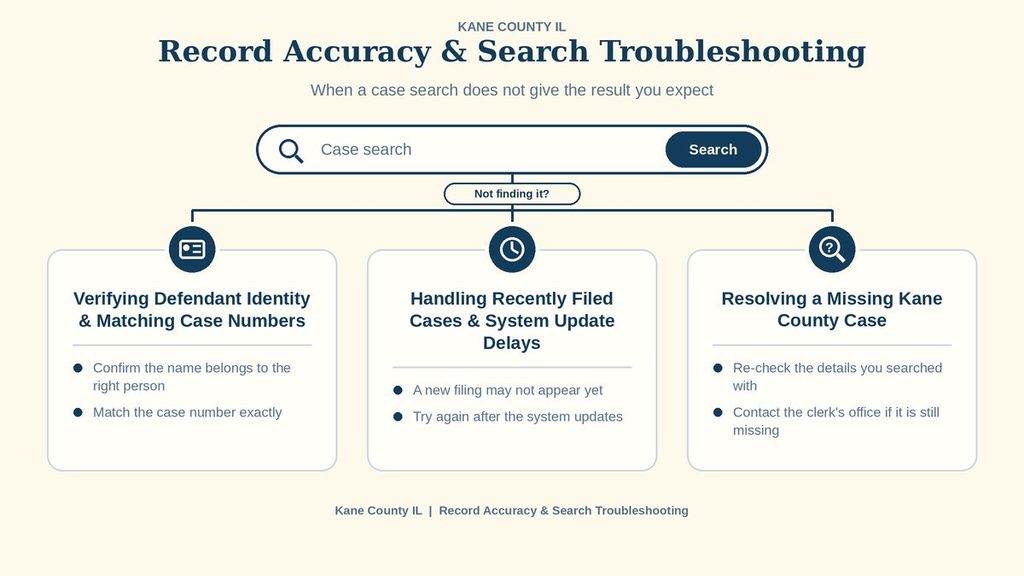
Verifying Defendant Identity & Matching Case Numbers
Begin with the most exact identifier the record allows. A case number removes many name-based doubts. A name search still requires careful comparison because legal names can change and separate cases may have similar party names.
- Use the full case number, including every prefix, suffix, and digit shown on an earlier court paper or case notice.
- When searching by name, type the defendant’s full legal name as shown in the case rather than a nickname or shortened form.
- Compare the court name. A County Court at Law result and a District Court result are separate dockets even when the party name is identical.
- Match the charge, case type, and filing date shown in the result with the court paper or notice you are checking.
- Review each returned case before selecting one. A defendant may have several cases with different numbers, charges, or case stages.
- Confirm at least two matching details, such as the name and case number, before requesting a copy or relying on the result.
A surname can be shared by many people. A first name can also be used by more than one person in the same county. Matching the criminal charge and court date reduces that risk. If two results appear nearly identical, obtain the case numbers and compare the full captions.
Handling Recently Filed Cases & System Update Delays
A newly filed case may exist before its details appear in the public search. Staff must enter the case into the system used for viewing, and the filing may need to reach the correct court index. A document filed near the end of the day may also be processed on a later business day. For that reason, an absent result does not by itself prove that no case was filed.
System maintenance or an update can affect search results or produce a temporary error. Record the date and time of the failed search, the search term, and any message shown on the page. Try the exact case number in a separate search. A case-number search can help determine whether the problem concerns the name field or the entire result list.
Resolving a Missing Kane County Case
Some older or less common records may not appear in the online service. A failed search can also result from an incorrect name, the wrong county, or a case that has not yet reached the public index. Use a short checklist before deciding that the case cannot be found.
- Search with the complete case number if a paper, notice, charging document, or attorney record provides one.
- Try the defendant’s full legal name with each documented spelling variation.
- Check both the County Court at Law and District Court context when the search page allows court selection.
- Confirm that the search is for Kane County and that the case number or name belongs to that county’s Circuit Court.
- Compare the filing year and court name with any paper record you hold, since several cases may look similar.
- Ask the Circuit Clerk to check the case and the availability of documents that do not appear online.
Give the clerk enough detail to find the file without guessing. A case number, exact party name, court, approximate filing date, and known charge form a strong request. If no case number exists, state that fact and list the name and date details you used.
Contact Information
Use these details for criminal case-record questions and document requests. Provide the case number, full name, and filing date when available. These details can help identify the correct court record and reduce search errors. Contact the relevant clerk’s office for information about document access, availability, and applicable fees.
- Office: Kane County Circuit Clerk, 540 S. Randall Road, St. Charles, IL 60174
- Phone: 630-232-3413
- Main office hours: Monday-Friday, 8:30 a.m.-4:30 p.m.
Frequently Asked Questions
Criminal court records give a clear view of a case’s history, charges, and outcomes. Accessing these files helps victims, attorneys, and the public verify facts, prepare for hearings, or simply stay informed. In Kane County, the Circuit Clerk’s online portal lets you search by name, case number, or docket entry, then view filings, hearing dates, and final judgments. Knowing how to locate and interpret this information saves time and avoids unnecessary trips to the clerk’s office.
How can I search criminal court records in Kane County?
Visit the Circuit Clerk’s online portal, enter the defendant’s name or case number, and click Search. The system displays charges, docket entries, hearing dates, and case disposition. Review the summary, then use the “Download” button for official PDFs. If the record is not online, call the clerk’s office at 630‑232‑3413 to request a copy.
What information is included in a criminal case lookup?
A criminal case lookup shows the case number, filing date, offense type, involved parties, and a timeline of docket entries. You’ll also see court hearing dates, any motions filed, and the final judgment or disposition. This snapshot helps you understand the case flow without reading every document.
Can I find misdemeanor court records using a defendant name search?
Yes. Select “Misdemeanor” from the filter menu, type the defendant’s full name, and run the search. Results list all misdemeanor filings for that person, including charge details and hearing outcomes. Use the case number to drill down into each docket entry.
How do I locate a criminal case number when I only know the defendant’s name?
Start with a name‑based search on the online portal. The results page shows each matching case with its unique number. Click the case title to open the full docket, where the case number appears at the top. Note this number for future reference or when contacting the clerk.
What steps should I follow to obtain a copy of a criminal docket record?
After locating the case, click the “Download” icon next to the docket entry you need. If the file is restricted, submit a request form through the portal or call the clerk’s office during business hours. Provide the case number, your contact details, and payment method for any copying fees.